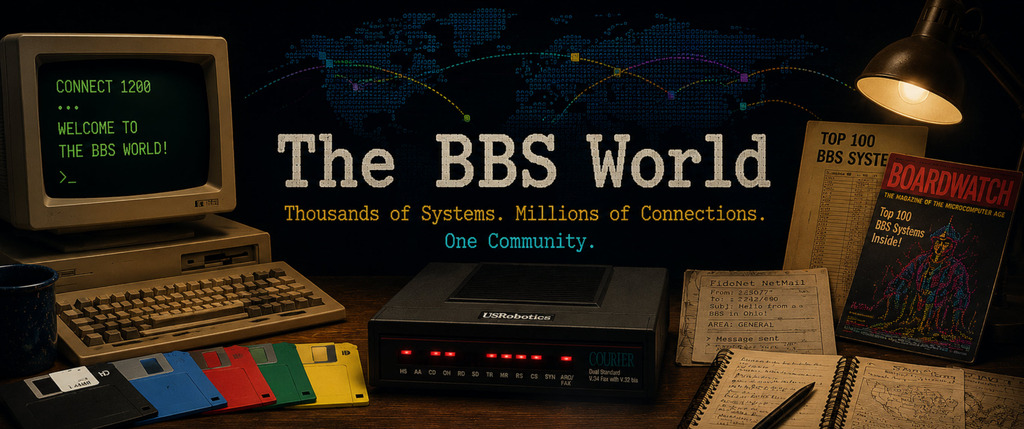
When local people ask me about Digicom's history, they're often surprised to learn that we weren't the only nor first bulletin board system in town, and we certainly weren't the biggest in the country.
The truth is, Digicom was just one small part of something much larger.
During the 1980s and early 1990s, thousands of Bulletin Board Systems quietly connected people all over the world. Some were built by teenagers or adults in their bedrooms. Others were operated by businesses with racks of computers and dozens of incoming phone lines. They all had one thing in common: someone loved computers enough to invite complete strangers to dial into their system.
Long before the Internet became a household word, these bulletin boards were where friendships were formed, software was shared, and ideas traveled from one side of the country to the other. Looking back, it's easy to focus on the technology, but that isn't what made the BBS era special. It was the people.
My own introduction to that world wasn't through Digicom at all. Before Digicom was ever online, Evansville already had a thriving BBS service, Compu-Press, operated by Tony Ubelhor. Like so many curious tech-adventurers, I called looking for computer things and found something much bigger. Through Compu-Press I met Tony, Terry McConnell, and others who welcomed newcomers, answered questions, and freely shared what they had learned. They weren't just running a bulletin board. They were building a community.
That willingness to help each other wasn't unique to Evansville. It seemed to exist everywhere. SysOps shared ideas, traded software, solved programming problems, and encouraged one another to keep building better systems. There was certainly a little friendly competition, but there was also a feeling that every new bulletin board made the entire hobby stronger.
Some systems became famous. Names like Exec-PC in Wisconsin and CompuServe were known by computer enthusiasts across the country. Logging into one of those systems felt almost like visiting another city. They had massive file libraries, busy discussion forums, online games, and callers from all over North America. They showed what was possible when a bulletin board kept growing.
Yet those famous systems were never more important than the little one-line board operated out of someone's spare bedroom.
One of the things I loved most about the BBS world was that success wasn't measured by how many phone lines you owned or how many callers you had. Some boards existed simply so a few friends could stay in touch after school. Others served a local computer club or a handful of amateur radio operators. Some never had more than a dozen regular callers, but those callers checked in every single day. To the people who used them, those little systems meant just as much as the giant boards everyone had heard about.
As bulletin boards became more popular, they also became more connected. Networks like FidoNet allowed messages to travel from one BBS to another, sometimes reaching the other side of the world without the person writing the message ever making a long-distance phone call. Later, commercial networks like SprintNet made it affordable to reach bulletin boards in distant cities by dialing a local access number. Suddenly, the BBS world felt much smaller, and yet much larger at the same time. You were no longer limited to the boards in your hometown. The entire country began to feel like one giant community.
If you were serious about bulletin boards, you probably had a subscription to Boardwatch Magazine. Every issue was packed with news about faster modems, new BBS software, hardware reviews, and stories about systems from around the country. Then came the annual Top 100 BBS issue. Every SysOp flipped through those pages to see who made the list. It wasn't just about bragging rights. It was recognition from people who understood the countless hours it took to keep a bulletin board running and your callers happy.
Eventually, the Internet changed everything. One by one, bulletin boards began disappearing as websites, email, and web browsers took over. Some SysOps shut down their systems and moved on. Others adapted and became Internet Service Providers, web hosting companies, software developers, or IT businesses. Many of the skills that built the early Internet were learned while running bulletin boards.
When I think back on those years, I don't remember modem speeds or hard drive sizes nearly as much as I remember the people. I remember the excitement of hearing a new caller log in. I remember the conversations that lasted late into the night. I remember meeting people who loved technology as much as I did. Those experiences shaped not only Digicom, but an entire generation of programmers, network administrators, business owners, and technology professionals. Even in the 1980s, one of our daily visitors, was blind. He had technology that would read what was on the screen to him, and after 100s of conversations, I didn't know until I called him in person one day.
Digicom's story is only one small chapter in the BBS history, but it is far from the only chapter. Every bulletin board, whether it had one phone line or one hundred, helped create an era unlike anything before or since. Together they proved that ordinary people, armed with little more than a computer, a modem, and a telephone line, could build communities that stretched far beyond their own neighborhoods.
And for those of us who were lucky enough to be there, it was an amazing time to be online.
